

How To Install An Msd Ignition System
Past Bob Wilson The examination mule in this case is a 1969 Ford Mustang Fastback, affectionately dubbed Ol' Paint (for lack thereof). Recently installed in the engine bay is a major update to the factory 351 Windsor two-butt engine. The engine at present is a bored and stroked version of the 351 displacing 395 cubic inches. The mill features a Declension Loftier Operation Stroker Kit, increasing the stroke from the manufactory 3.fifty inches to 3.85 inches, utilizing Probe forged 302 pistons, and stock 351 rods and rod bolts. Consecration for the engine is via a Holley 750cfm 4 barrel with vacuum secondaries, an Edelbrock Performer RPM intake, cam and aluminum cylinder heads, all exiting through Hedman coated shorty headers (or Hedders!) and mandrel bent 2.5-inch dual frazzle. A manufacturing plant stock distributor with a custom recurve, a Pertonix Ignitor ignition unit, and a Pertronix Flame Thrower gyre supplies ignition. This was an area that I thought needed assistance. Ford protects their stock coils from overheating by providing a resistor wire to the whorl, reducing voltage in the run position from 12v battery voltage to virtually eight-9 volts. That'southward bang-up for stock applications, and ringlet longevity, only it's non so great for optimum performance. And to add insult to injury, the resistor wire runs from the ignition switch in the dash to the wire junction cake at the firewall. That means to remove the resistor wire and supercede information technology with a standard wire, y'all demand to completely remove the nuance. I have done that before for other repairs, and I am in no hurry to exercise information technology once more. The simple solution to getting the ignition organisation on par with the other high performance componentry is to add an MSD Capacitive Belch box to my ignition system. While the Pertronix organisation was adequate, the MSD-6AL box has some features that piece of work really well for this application. The first characteristic that is really bonny is an adjustable rev limiter. While the Coast Stroker kit is nice and affordable, one area where it nether whelms is the stock rods and rod bolts. The engine, with the Performer RPM package, well rev fairly easily to 6500-7000 rpm, which is dangerous territory for this hardware. The 6AL box has a rev limiter that has a small module that can be inserted to tailor the engine cut-off to your detail engine's needs. These are available in 100 rpm increments, so just nearly any cut off point will exist available to you lot. This particular engine should never go past 6500 rpm, and I prefer a 6000 rpm cut-off for added insurance. Some other bonus is that the MSD box connects directly to your battery as well every bit your coil wire, and the voltage to the scroll comes directly from the box, so the weak 8-9 volt mill curlicue voltage is no longer a concern. I will at present exist able to get the maximum voltage to the coil without removing the dash and coil feed wire. A third benefit, of course, is functioning. The RPM bundle from Edelbrock is surprisingly racy, and it idles with a noticeable lope and only ten to 12 inches of vacuum. The multiple sparks that occur with this box under 3000 rpm should greatly help beginning-up and depression rpm drivability. With the conclusion made, obtaining the MSD unit of measurement is as unproblematic as visiting your local speed shop, or sending away to your not so local speed shop. The 6AL box is a universal application piece of equipment, and any retailer that is halfway serious about performance will have one in stock waiting for you lot. After I got my CD box, and started the install, I decided to besides order the MSD Blaster coil, which is a better fit for this system, and a prissy new set of MSD pre-fit plug wires, which will perform well and expect a lot better than with the old wires currently in place. On with the install!
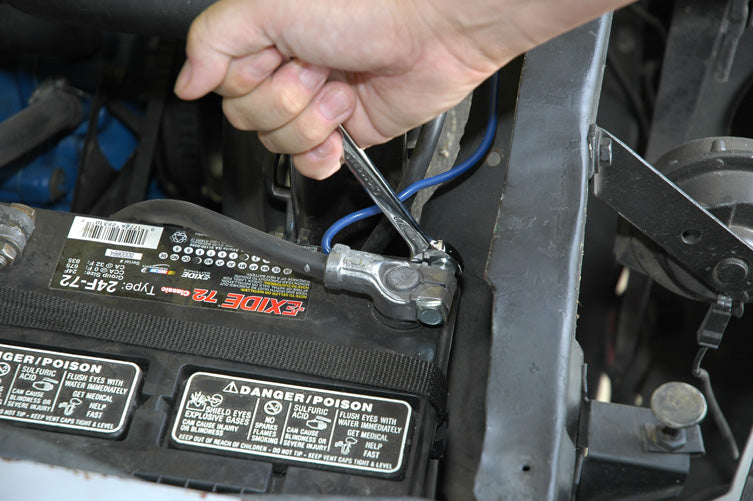
The first step for whatsoever electrical work on whatsoever car is to disconnect the battery. This volition prevent unexpected voltages and spark from damaging your components and you!

Fix the cablevision aside so that information technology is out of the way. We will be connecting the MSD box to the battery afterward, so be certain to disconnect both cables.
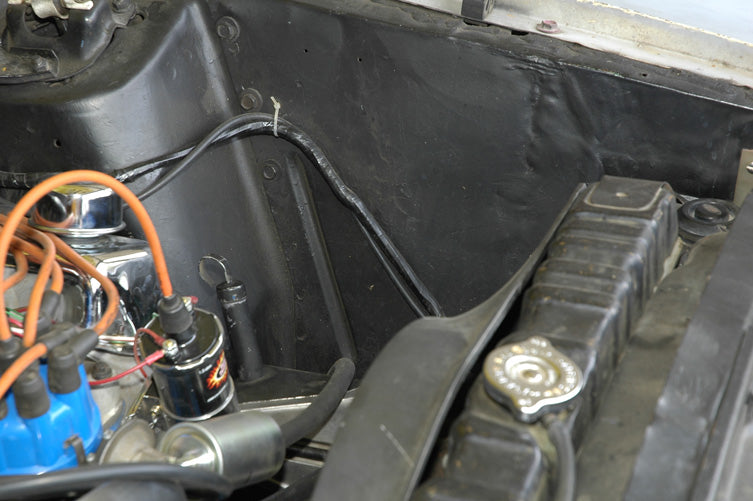
The showtime thing to do after disconnecting the cablevision is to decide on a location where you would similar to mount the MSD box. The box tin can be mounted anywhere, although a more than remote location such is in the interior of the car will crave y'all to splice and solder more wire into the harness provided, a fairly easy chore. Many vintage GM musclecars take a nice spot to mountain the box on the passenger side of the firewall, while Fords offer a nice location on the fender well side by side to the washer fluid reservoir. As you can see by this photo of my mounting location, the canvas metal is a fiddling less than perfect, due to a movable Ol' Paint coming into contact with an immovable fixed object, courtesy of the previous owner. Fortunately, the 6AL box comes with rubber mounts that actually concord the box about ½ inch off of the mounting surface, and then irregularities in the mounting surface tin can be easily overcome.

Since the console that I am mounting the MSD box to will exist replaced when Ol' Paint becomes "New Paint", I am not too fussy with perfection in the mounting. To locate the first hole to drill in the panel, y'all can simply use a metal dial or screwdriver to scribe the location. If you lot want the MSD box to be perfectly level, you can drill the offset hole so install the first screw loosely while scribing the second pigsty, using a carpenters level. Every bit long as Ol' Pigment remains Ol' Paint, I will not be and then fussy.

Another method to scribe the iv holes that will need to be drilled can exist to make a paper template with the box on your workbench, equally shown here. Dial holes in the paper afterward you take marked all 4 with a pen or pencil, and so scribe the mounting location on your car. Either style will work. If you are concerned well-nigh the box being perfectly level, measure twice before you drill. Nobody wants extra holes in their firewall.

Advisedly drill the holes in your mounting location. Make sure there is nothing on the other side that yous can damage with the drill chip when it goes through.
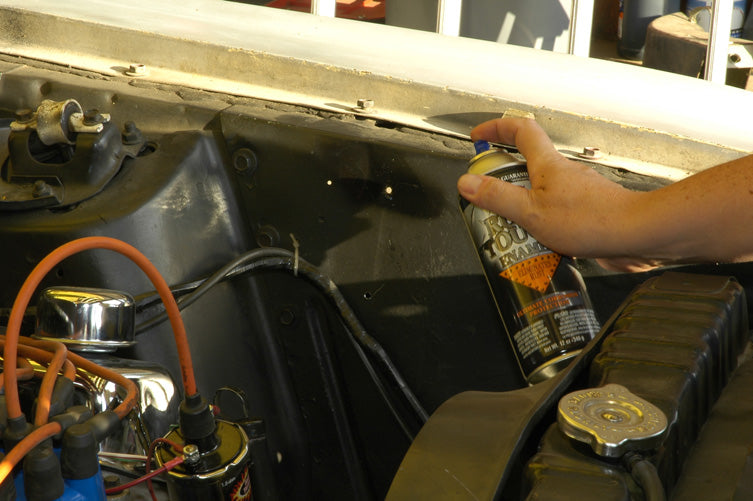
Rather than go out bare metallic exposed to the elements, I splashed a quick squirt of engine bay pigment to protect the canvass metallic from rusting when it gets wet.
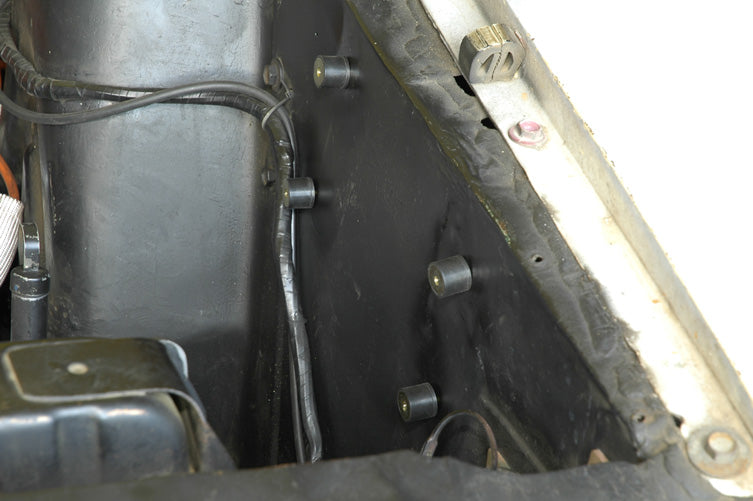
After drilling all four holes, loosely mount the 4 condom grommets to the mounting location. It is important not to fully tighten them however, as imperfect mounting surfaces like mine will brand alignment with the box itself very hard.

Position the box in place and install all 4 screws into the previously mounted safe grommets. Once you have all the screws started, you can now tighten all screws and bolts, as bolt alignment is at present bodacious.
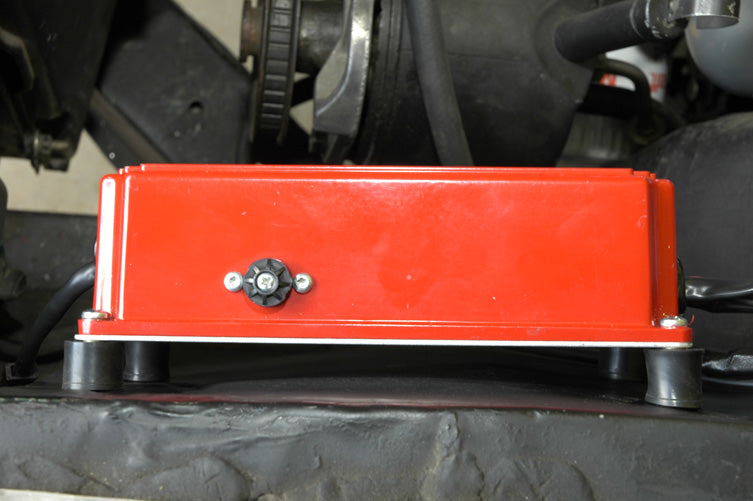
Hither is a view of the mounted box from above. As you tin can come across, the mounting location is non entirely apartment. The rubber grommets practise a great job of making mounting location irregularities irrelevant, and they too help in air circulation around the box, helping to proceed the box cool.
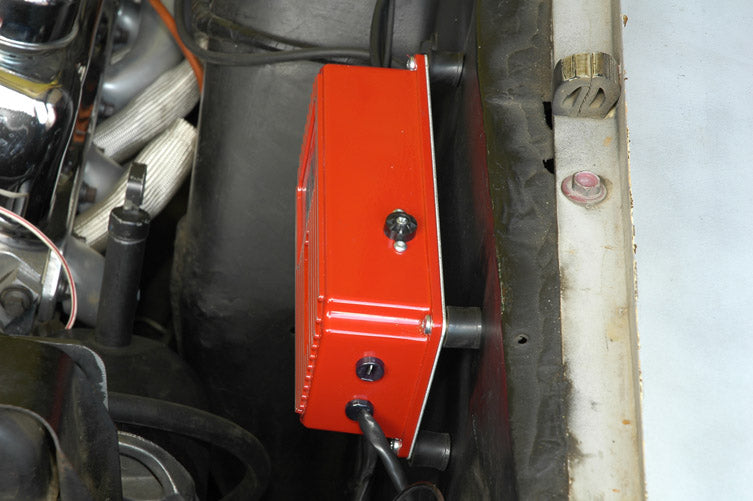
This view of the mounted box reveals two wiring connections. The meridian slot is the tach output terminal, for those running a tachometer, and the Magnetic Pickup Connector harness at the lesser is for those running an MSD benefactor or crank trigger, factory or aftermarket magnetic pickups. Since I will be using my Pertronix Ignitor equally a trigger, which is wired just like factory points, I will not need to utilize this harness. If you take any doubts virtually wiring an MSD 6AL into your organization, yous can simply download a PDF of the complete installation instructions, which includes simple wiring diagrams for all the nigh common systems, including points and/or Pertronix Ignitors.
People are frequently very surprised that you can even so apply a points style organization with an MSD CD box. Since the box handles all the voltages, it simply uses the points as a trigger. Since high voltages no longer travel across the points, a CD box actually greatly increases the life of the points. The only caveat with points is their ability to mechanically keep upwards at very high RPM, but for daily driver employ, points can work great with the MSD box.
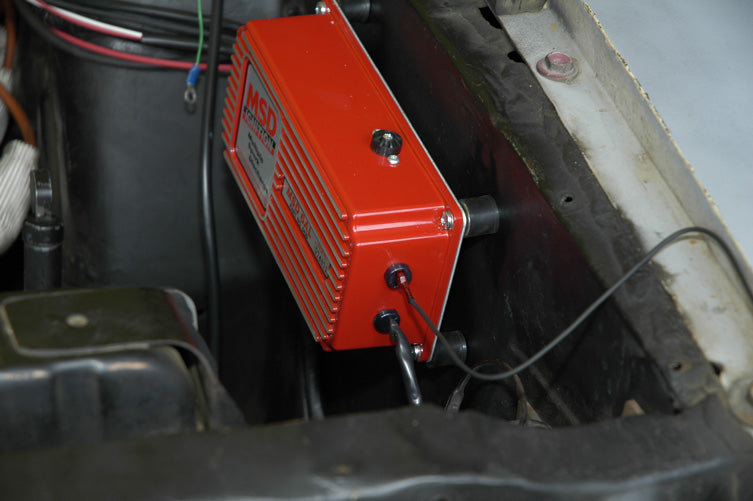
The first wiring job I will tackle is connecting the tachometer. MSD provides a wire as part of the set, so merely plug it in to the box as shown here. Some tachometers demand an adaptor to work properly with the box, and in that location is a handy Tachometer Compatibility List in the instructions that come with the box. It would be a practiced thought to download the PDF ahead of time so that y'all can lodge whatever necessary adaptors at the same time that you guild the box.
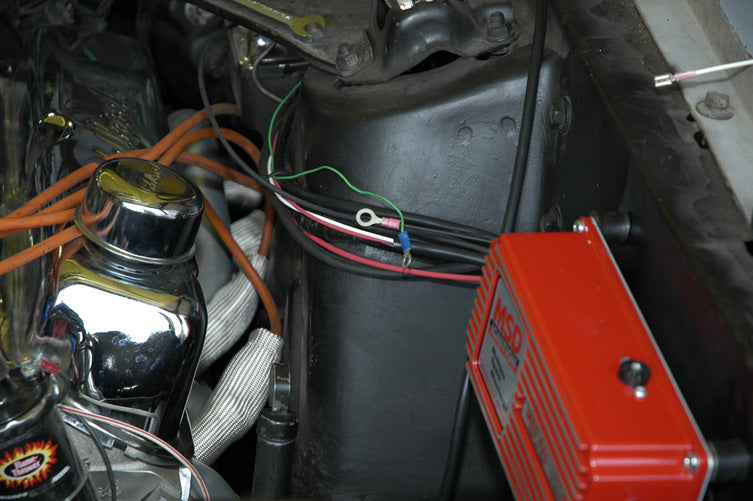
The other end of the tach connector is the blackness wire that you see with the eyelet, and the tach wire to my AutoMeter tach is the green wire, which also has an eyelet, as it used to exist connected to the coil. As with whatsoever electrical component installation, you lot volition usually encounter situations similar this. I am going to clip off both eyelets and solder a permanent connexion with shrink tubing for protection from the elements. While the MSD installation kit offers diverse quick connect connectors for this, I adopt to make many of my connections equally permanent every bit possible, and properly soldering and connecting wires is actually fairly simple, as this next sequence will illustrate. To practice this yous volition need a skilful wire stripper/cutter, and a decent soldering iron or pencil, as well every bit some solder and shrink tubing. All are available at hardware, home and auto parts stores.

The get-go step is to clip off the eyelets of the two wires that will be soldered together. I have already clipped the green wire and the blackness wire is shown here.
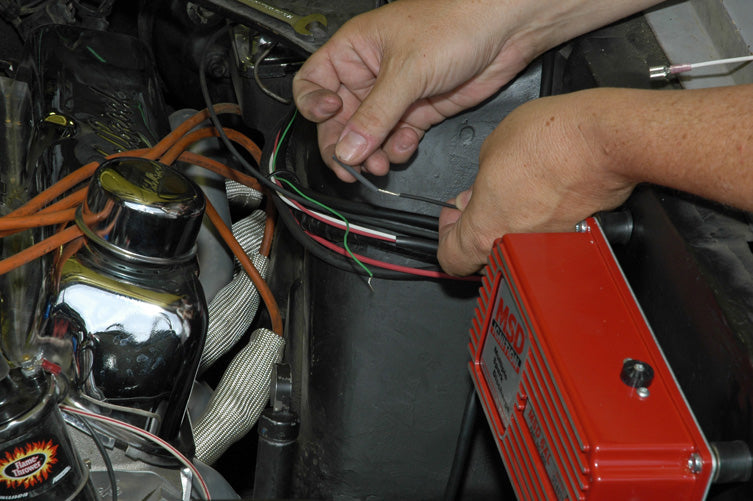
Before twisting the two wires together, be sure non to forget to slide a slice of shrink tubing over one of the wires. Yous tin can't get the tubing on once the wires are continued, and so don't forget.
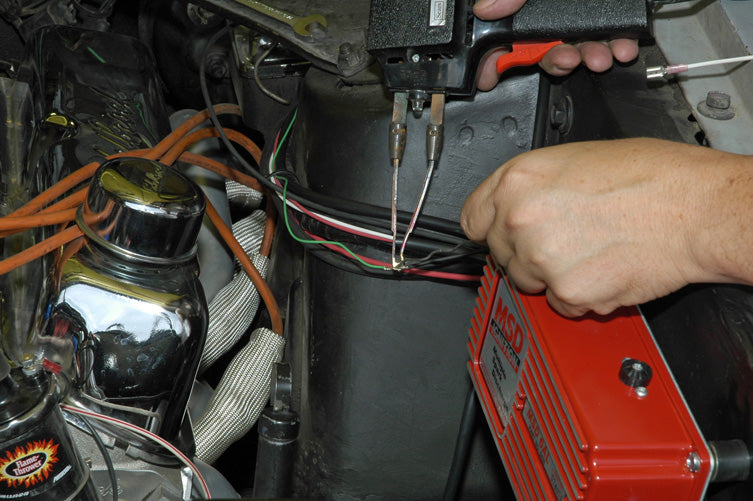
Later on clipping the ii ends off the wires and installing the shrink tubing, strip a pocket-sized department of insulation off the end of each wire, allowing just enough blank wire for you lot to twist the bare ends of each wire together. After twisting them together, get the wires hot with the soldering gun and apply the solder.
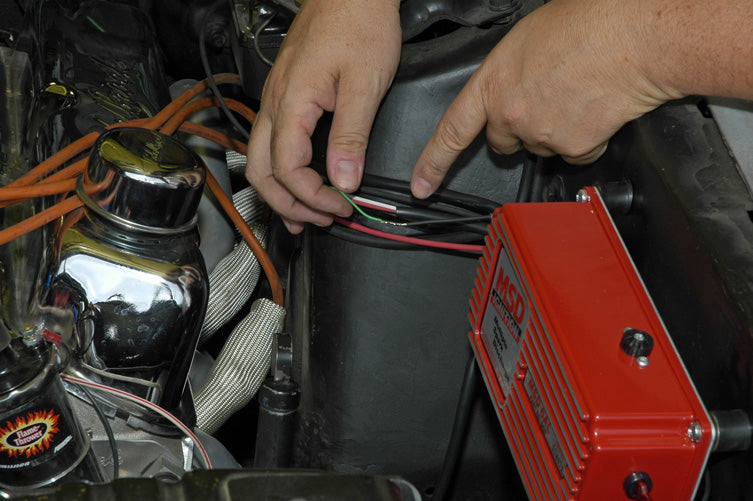
This is what a freshly soldered connection looks like. The solder will melt into the wires and create an excellent connectedness.
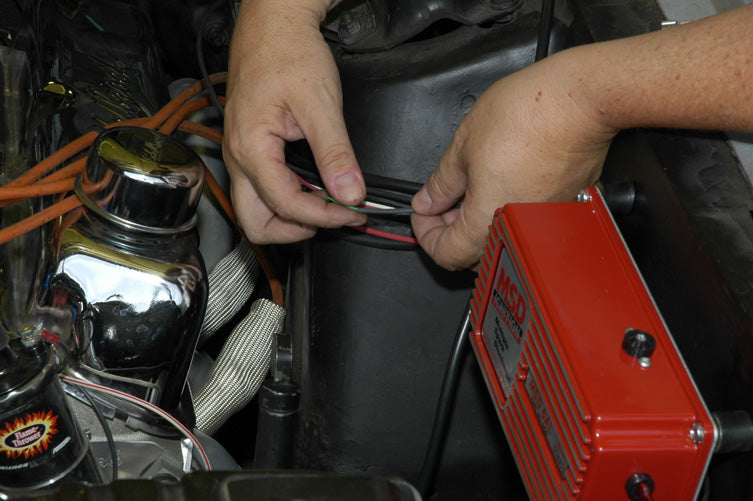
Permit the connexion cool a footling bit and slide the installed slice of compress tubing over the freshly soldered connection.
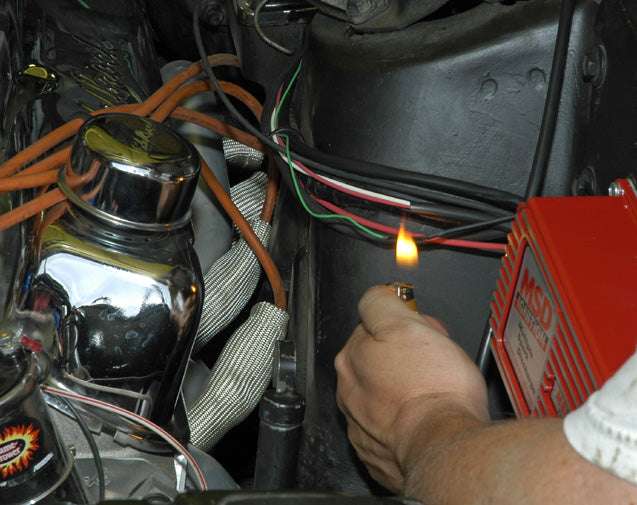
Subsequently you accept placed the shrink tubing over the fresh connexion, light a match or disposable lighter under the shrink tubing. Yous will now see why information technology is called shrink tubing, as the tubing contracts over the connection, making a elementary and cheap weatherproof seal. Shrink tubing works much better than electrical tape, and is less likely to be adversely effected past harsh, nether hood conditions. I make the majority of my direct wiring connections this way, especially connections that I don't anticipate disconnecting whatsoever time in the near futurity. For connections that are oftentimes undone and reconnected, quick connector or spade terminal connection will probably piece of work a little better. The connections I made from the MSD box direct to the battery were besides fabricated the aforementioned fashion, every bit I had to add together length to the wires to go them to accomplish.
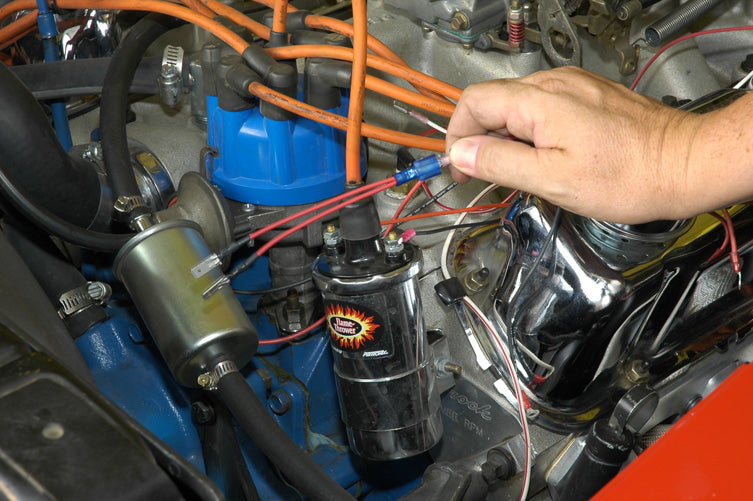
Now it is fourth dimension to connect the box to the distributor and coil. There are a number of wires coming out of the wiring harness connected to the MSD box. 1 small harness has the orange and black wires. These will be the wires going to the whorl. The other pocket-size harness has the small approximate red and white wires, and there are 2 heavy approximate red and black wires coming directly from the box. The heavy gauge wires volition be the ones going to the battery, so we volition get to those subsequently.
The first set of wires that we volition address is the crimson and white wires that will exist connecting to the distributor, and in my case, the Pertronix ignition trigger. Shown here is a two into one connector provided in the install kit. The small red wire coming from the MSD box will exist connecting to the red wire coming from the Pertronix Ignitor in the benefactor, and the red wire will likewise have to connect to the ignition feed wire that used to run to the coil from the ignition switch. This is the resisted 8-nine volt wire I referred to in the introduction. This handy connector will let me to hands connect the two factory wires to the one red MSD wire. I take already attached the connector to the MSD blood-red wire, equally shown.
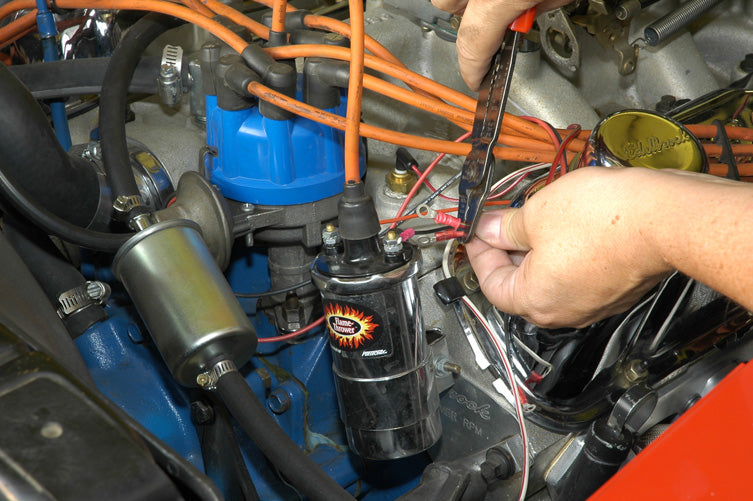
Since the manufacturing plant wires originally connected to the coil, they had eyelets on them. Since I will be connecting these wires to the connector shown in the previous photograph, I will demand to convert these to spade terminals. Here I am cutting off the eyelets so that I tin attach the spade terminals.
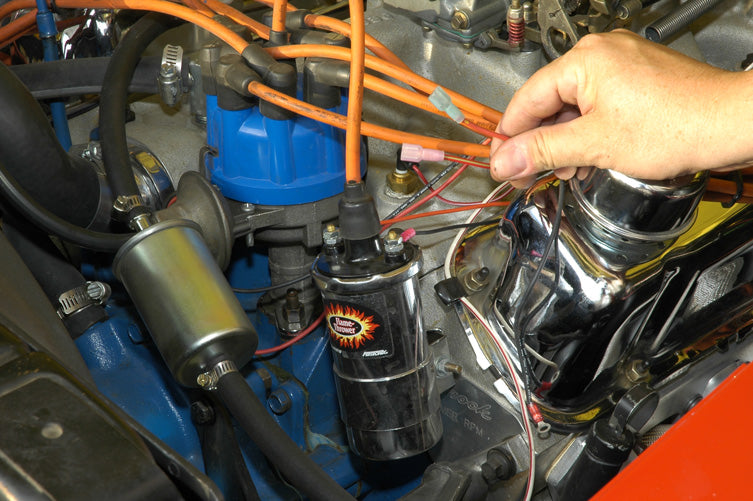
Here I have crimped two spade terminals that I had in stock from a simple terminal set from the home improvement store. You tin get these in big array kits inexpensively and they are ever handy to have effectually for projects similar this one, aftermarket gauges, and machine stereos. Buy them ahead of time so you lot don't have to run to the store during your install.
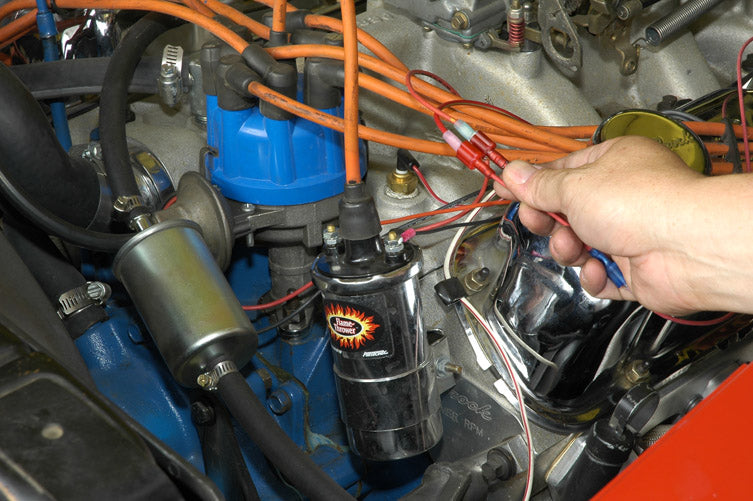
Here are the continued spade terminals. Make sure the terminals are fully covered, so that a live wire can't come into contact with footing, shorting your components. I decided to go with this blazon of connecter to allow for like shooting fish in a barrel disconnect should I have a component failure in the hereafter, similar the Pertronix unit of measurement failing.
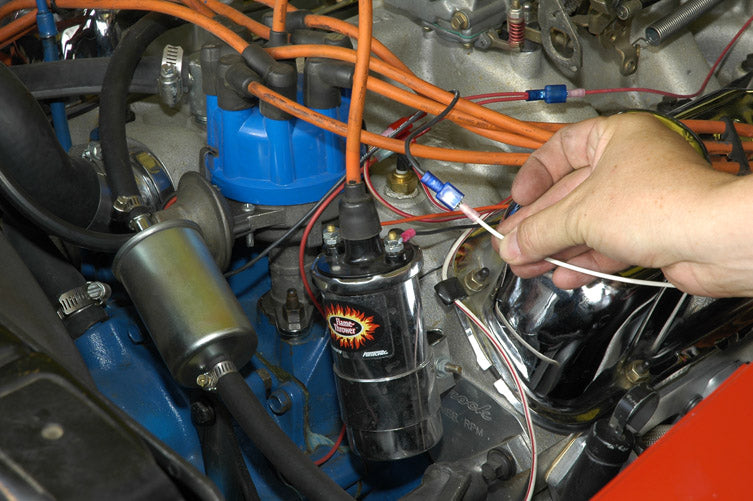
I have done the same thing with the white wire from the MSD box, connecting it to the blackness wire from the Pertronix unit. This is a simple ane wire to ane wire connection. At present the distributor is connected, it'south time to hook up the coil.
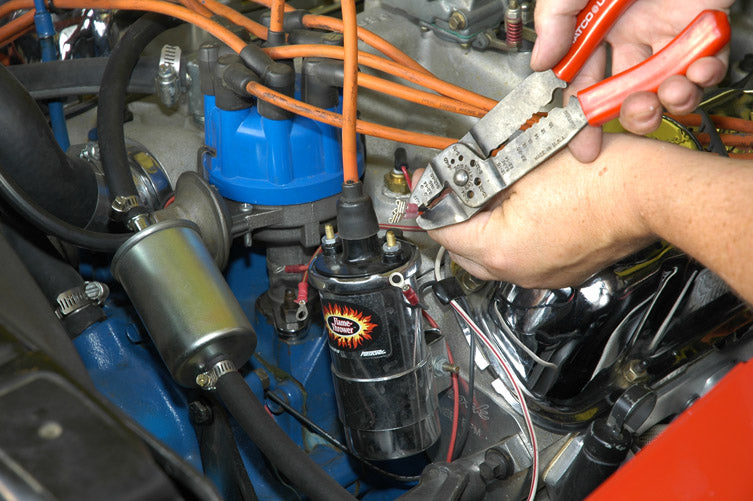
The orange and black wires from the second mini-harness from the MSD box are the wires that you will exist connecting to the curl. These are the Simply wires that volition be connected to the coil. The MSD wiring harness comes equipped with spade terminals, which with the provided adaptors, can be connected directly to the coil without modification. I tend to prefer eyelets for my roll connections, as they are more than difficult to pull off the coil when working on other things. They likewise provide a more directly connection, and then I am going to cut off the spade terminals and switch over to eyelets. I am too going to switch over to the MSD Blaster coil, as it is better suited to the MSD system. The Pertronix roll internally has 1.v ohms resistance, which is required for certain systems. The MSD coil has less resistance, which is perfect for the MSD 6AL system.
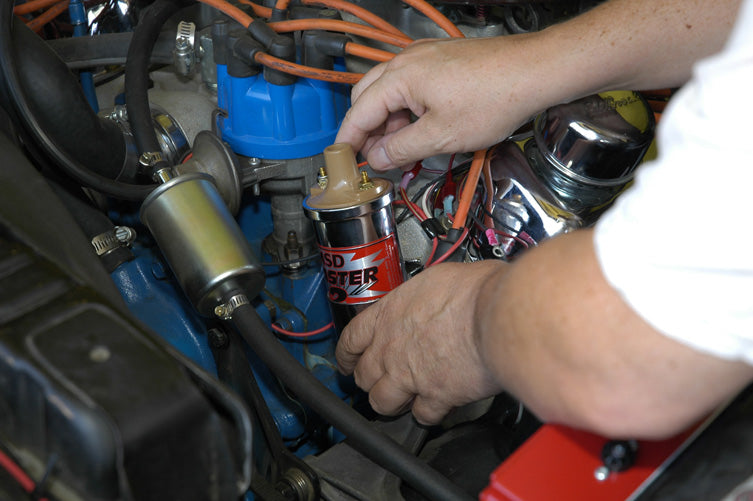
With the new coil in identify, attach the orangish wire to the positive concluding of the coil, and the ballyhoo wire to the negative terminal.
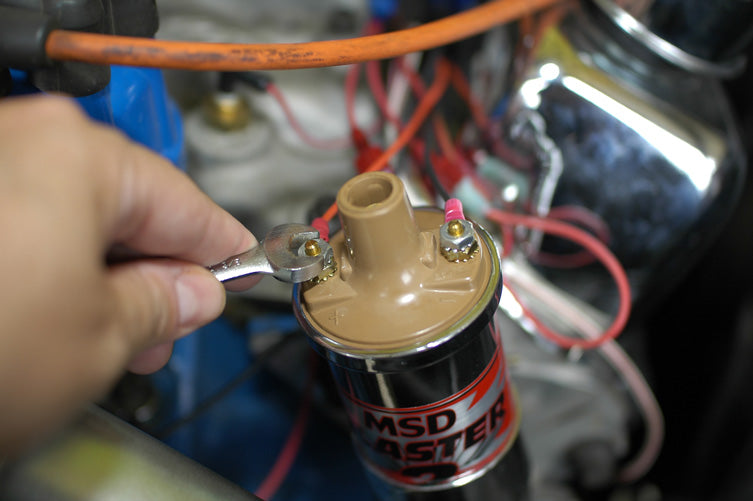
Gently tighten the nuts in place on the gyre. Exist careful not to over tighten, every bit many a good coil has been thrown away due to stripped threads on the coil posts. I volition become to those ugly plug wires in a minute. Nosotros notwithstanding need to connect the heavy gauge red and black wires from the MSD box to the battery before nosotros can proceed any further.
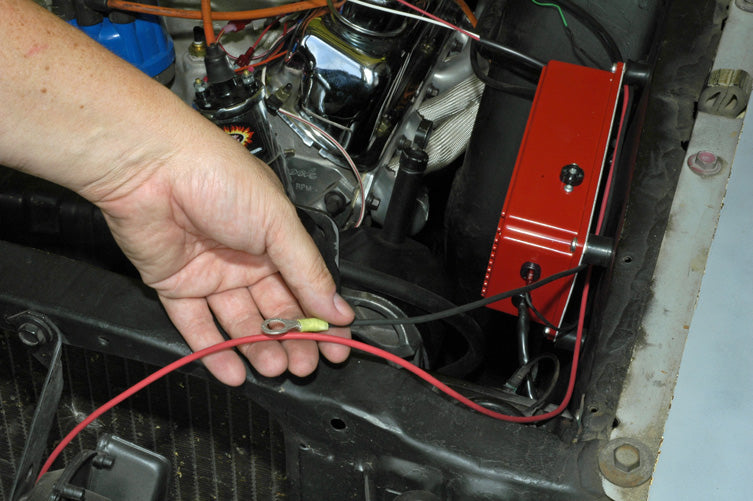
Here are the leads that will be going to the battery terminals. The factory supplied leads will not be long plenty for my awarding, as I plan to hide the wires on the behind of the radiator core support. That means I will have to splice in an extension to get the wires to reach the bombardment. I volition employ the same method as I did when soldering the tach wire.
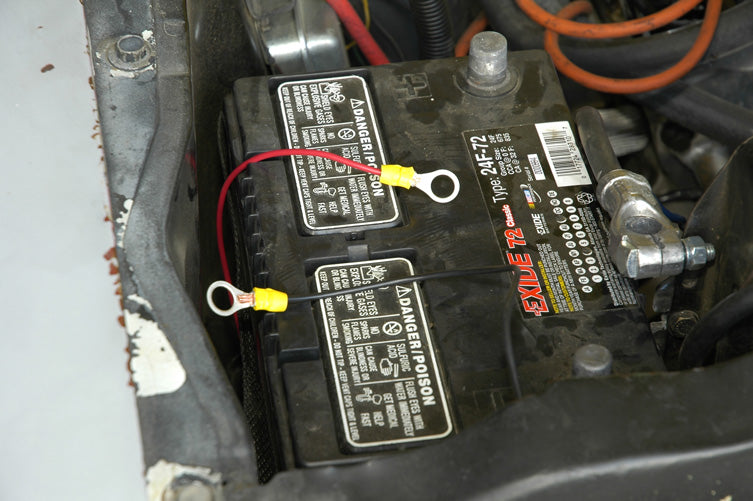
Here are the wires later splicing, measured to fit and so that at that place is no actress wire around the bombardment tray area.
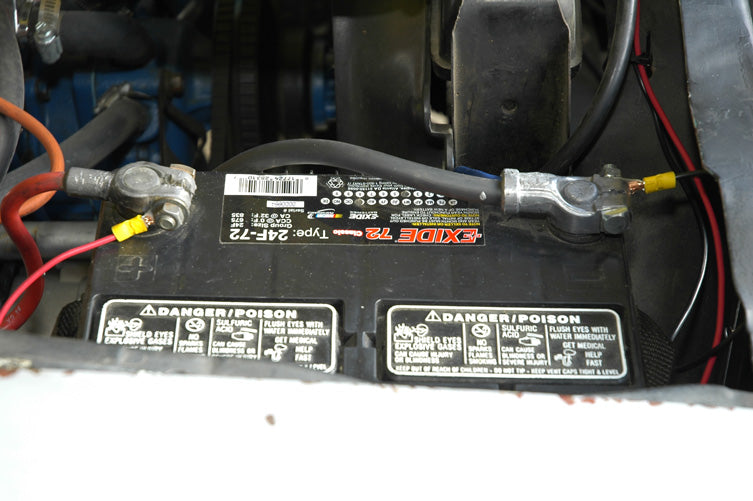
And here are the wires continued directly to the battery. At present to the plug wire replacement, and to re-gap the plugs to the recommendations provided in the MSD directions.
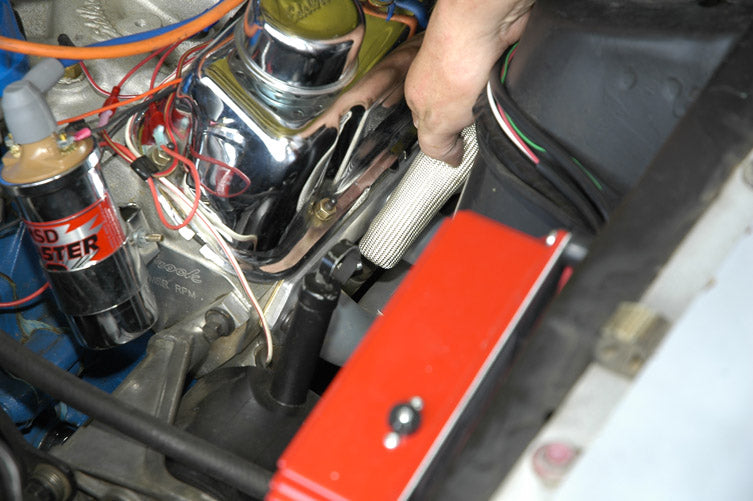
The next step for me, and this is optional, of class, is to re-gap the spark plugs to a wider gap setting, to take full advantage of all that extra spark. This volition aid in more complete combustion, and volition aid take full advantage of all the benefits that the 6AL provides. I use plug wire kicking protectors, as you can run across hither, as the clearances are rather tight in this application. These are very handy if y'all remember that your plug wires will come up into contact at any point with your headers.
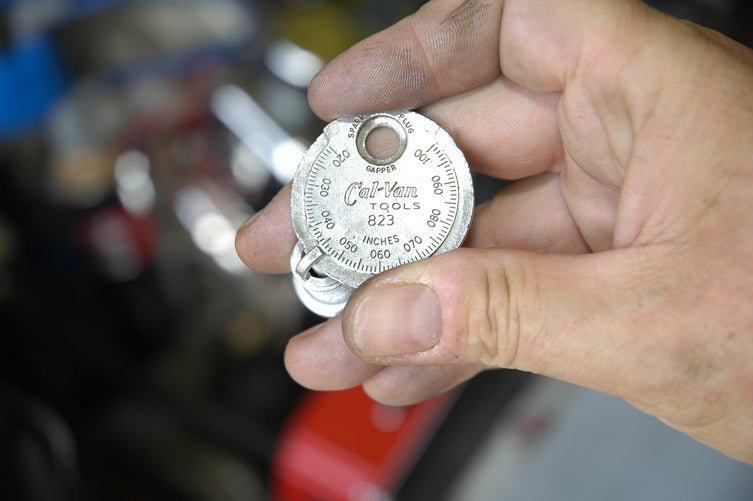
I set my plug gap to .045, which is slightly conservative for a 10.5:1 compression engine. This will be a good starting signal, and I can experiment with different gaps later.
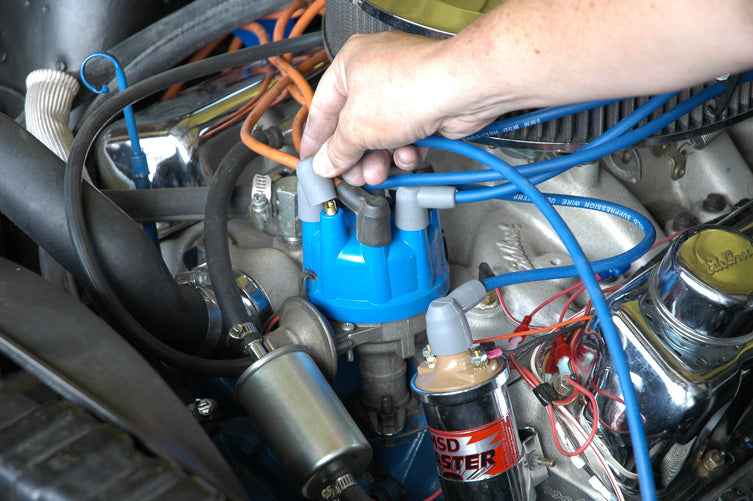
And nor for the final task, installing the new MSD Heli-Core spark plug wires. Not merely volition these wires make my engine bay wait a lot nicer, they will prevent crossfire, provide a prissy hot spark, and provide good radio static suppression.
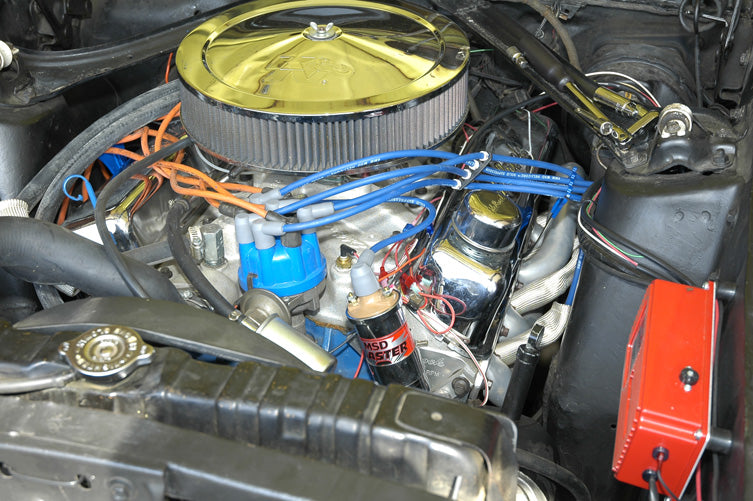
And hither is the completed look. I will get some decorative wire wrap to clean up the look in the ringlet area as time allows.
Conclusion Initial start-upwardly after this install was instant. I noticed immediately that the car was much more willing to idle on common cold starting time-up. Before the MSD install, I had to feather the throttle a bit for a few minutes to get the car to the point where I could put information technology in gear and go. Now the car idles on information technology'south own right away. Throttle response is also instant. Around town drivability is much improved. I oasis't put the machine on a dyno nevertheless, just seat-of-the-pants feel indicates that I have gained some horsepower. Also, I used to have a slight surge while cruising at expressway speeds when lifting off the throttle, or on very lite acceleration, which I could live with, just it was annoying. With the installation of this box, that problem went abroad as well. Now I can go to other parts of the fine-tuning process knowing that my ignition organization is country of the art, and more than capable of handling any further operation mods I throw at information technology. That's a good feeling to take, and I highly recommend this organization for anybody running a modified street vehicle or street/strip weekend machine.

Source: https://www.cartechbooks.com/blogs/techtips/ignitioninstall
Posted by: doughertymazed1973.blogspot.com
0 Response to "How To Install An Msd Ignition System"
Post a Comment